
Xinmin Secondary School Eco-Garden
Education (Schools)
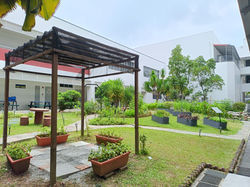


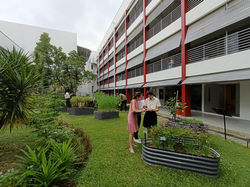


The 400 sqm Eco-Garden at Xinmin Secondary School was designed as a multi-functional outdoor classroom that integrates ecological learning, food education and student-led discovery. Thoughtfully planned around existing site features such as mature trees and a pond, the garden transforms under-utilised green space into a dynamic learning landscape.
The garden is organised into interconnected zones, each serving a distinct educational purpose.
The Butterfly Habitat Garden introduces students to biodiversity and plant-insect relationships through a curated mix of host, nectar and regionally-indigenous plants. Trellised pathways and informal trails encourage exploration while enhancing the walking experience through the garden.
A ginger habitat is designed around the existing pond, which has a suitable moist and humid microclimate for the plants to thrive.
Under the existing jackfruit trees, shade-adapted edible plants thrive, demonstrating Food Forest concepts. Students can observe unique plant adaptations such as waxy, hydrophobic leaves and drip tips, gaining insights into how plants survive in low-light environments.
To extend learning beyond the physical garden, plant labels are embedded with QR codes, allowing students to access an online plant database curated by the school. In total, the Eco-Garden houses over 30 plant species, with close to 400 plants across the site.
Through intentional design and close alignment with curriculum needs, Xinmin Secondary School’s Eco-Garden demonstrates how school gardens can support experiential learning, digital literacy and a deeper connection with nature.
At the centre of the Eco-Garden is the Edible Learning Garden, where six raised planters are dedicated to growing herbs and edible plants for Food and Consumer Education classes. Crops such as lemongrass, roselle and purple sweet potato allow students to experience the full growing cycle, from planting to harvesting. Variegated edible plants were intentionally included to support lessons on photosynthesis and chlorophyll.
A ginger habitat is designed around the existing pond, which has a suitable moist and humid microclimate for the plants to thrive.
Under the existing jackfruit trees, shade-adapted edible plants thrive, demonstrating Food Forest concepts. Students can observe unique plant adaptations such as waxy, hydrophobic leaves and drip tips, gaining insights into how plants survive in low-light environments.
To extend learning beyond the physical garden, plant labels are embedded with QR codes, allowing students to access an online plant database curated by the school. In total, the Eco-Garden houses over 30 plant species, with close to 400 plants across the site.
Through intentional design and close alignment with curriculum needs, Xinmin Secondary School’s Eco-Garden demonstrates how school gardens can support experiential learning, digital literacy and a deeper connection with nature.